

Introduction
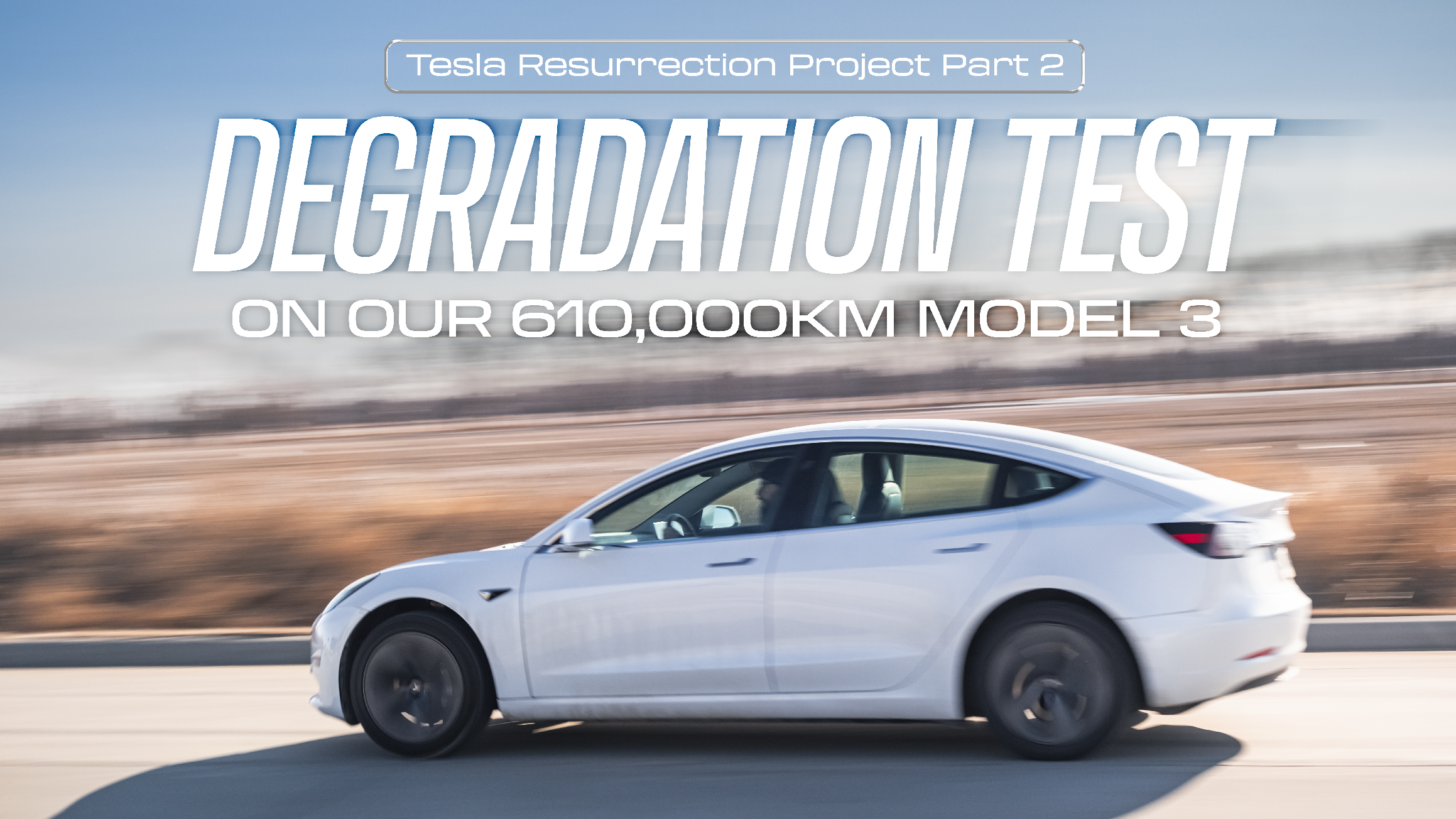
In this episode of the Tesla Resurrection series, the team continues working on their high-mileage 2019 Tesla Model 3 with over 610,000 km (about 379,000 miles) on the original battery and rear motor. After addressing issues at Tesla Service, we finally run the official battery health test to reveal exactly how much capacity remains.
The Challenges Before the Test
Day 2 – Starting the Battery Health Test
"All right, day number two and we're going to start doing our battery health test. The test I'm most excited about that's going to determine whether this car was a good purchase or a bad purchase and just how bad this battery is. 610,000km now. I think it's gonna be a pretty nasty result. So, let's go do it."
Immediate hiccups appeared right away:
- The car wouldn't unlock with the key card. (we didn't have app access yet)
- We suspected (and later confirmed) a dead 12V battery.
- To pop the hood, we had to remove the tow hook cover, which broke in the process (it was already zip-tied from previous repairs).
- We had to manually open the frunk and replace the 12V battery.
The team joked about "breaking into the car we just bought" and noted how the Model 3 feels like "Lego" with its modular design.
Battery Coolant Fault and Tesla Service Visit
We originally planned to run the test right after purchase but encountered a battery coolant fault. The service menu showed: "No battery or thermal alerts are active. See owner's manual for more information."
However, the indicators weren't green, so the test wouldn't start. We took the car back to Tesla Service for repairs before retrying.
How to Run Tesla's Official Battery Health Test
Once fixed and plugged into a charger, here’s the step-by-step process shown in the video:
- Ensure the car is in Park, plugged in to AC charging, and connected to the internet.
- Tap the car icon (bottom left on the screen).
- Go to Service > scroll down to Battery Health.
- Select Battery Health Test and hit Start Test.
The test takes up to 10–24 hours:
- It discharges the battery (running the heater to drain it quickly).
- Then charges it back to 100%.
- It measures the usable capacity compared to when new.
Eric guessed 61% remaining capacity before the results came in.
The Shocking Results
Next morning:
"Oh wow, 70%. So your battery is healthy. That is absolutely wild. 70%. That's incredible."
The test showed 70% battery health (with the car displaying ~89% charge at the time). The odometer read 610,433 km (~379,350 miles).
Eric was thoroughly impressed: "It's the original battery from Tesla, according to Tesla... I'm super impressed with how there's still 70% battery left after that amount of miles. It's absolutely insane."
Key Takeaways and Reactions
- 70% health after 610,000+ km on the original Panasonic NCA battery (likely a ~52–55 kWh pack in the early Standard Range Model 3) is impressive longevity.
- This suggests real-world degradation of roughly 30% over nearly 380,000 miles, which many viewers found better than expected for such extreme mileage.
- The car remains roadworthy and demonstrates strong EV durability.
Eric invites viewers to share guesses and comments: Was 70% more or less than you expected?
Conclusion and Series Outlook
"That's going to cap off this video on doing the battery health test... Make sure you guys subscribe to the channel. We got a whole lot more content that we're going to be doing with this Model 3 with our Tesla resurrection series."
The series will continue with mechanical refreshes, upgrades, paint protection film (PPF), and more transformations on this ultra-high-mileage Tesla.
Share:
600,000KM Tesla…What did we get into?
Model 3 Degradation Test Q&A