

I've driven Teslas almost exclusively since 2022. Four of them; two Model 3s and two Model Ys plus a short stint in a Ford F-150. Collectively that's close to 200,000 km of driving Tesla's, most of it road trips crisscrossing Canada and the United States. I know how a Tesla charges, how it plans a route, and how it feels after 12 hours behind the wheel. Teslas are what I know.
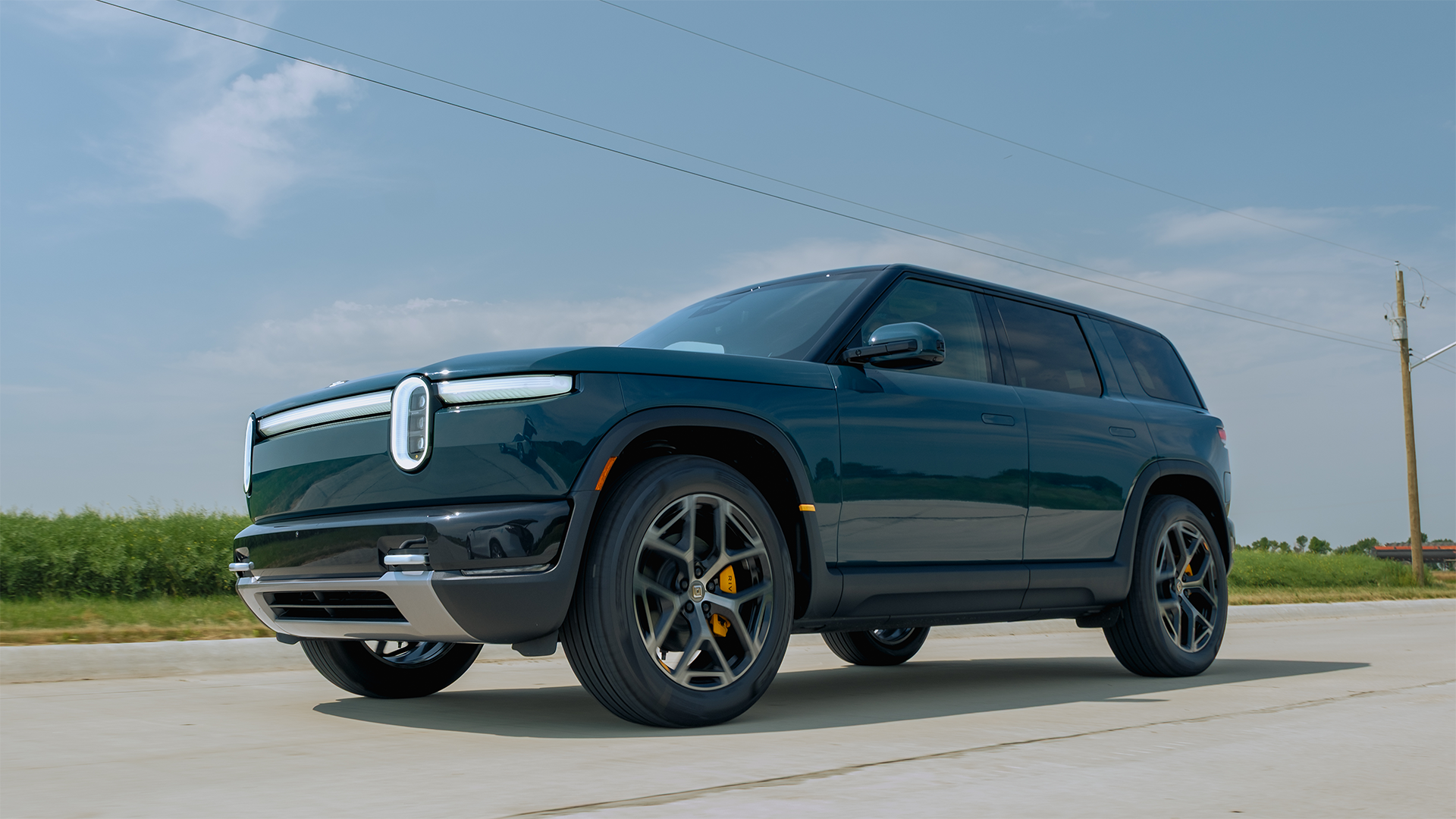
So when the chance came up to road trip a brand new 2027 Rivian R2 more than 1,100 miles from Fort Collins, Colorado all the way to our shop in Winkler, Manitoba I took it. We run a paint protection film channel, and the real reason for the trip was to scan this R2 and build our DIY PPF kits. But it also gave me the perfect excuse to answer a question I'd been sitting with: what is it actually like to road trip a non-Tesla EV when Tesla is all you've ever driven?
Here's the honest breakdown, the good and the bad. From someone who genuinely loves the Model Y and had no interest in switching.
The Rivian Route Planner vs. Tesla
Going in, I was almost certain the Rivian would route me differently than the path I've driven a dozen times in my Model 3 and Model Y. So the first thing I did was punch in our shop in Winkler and see what it wanted to do.
I was wrong and pleasantly surprised. The R2 laid out essentially the exact route I'd have chosen myself: up through Cheyenne and Gillette, Wyoming, into Montana, then east across North Dakota through Dickinson, Bismarck, and Jamestown into Fargo.
Where Tesla still pulls ahead is the dynamic re-routing. On a Tesla, the longer you sit at a charger, the smarter it gets. It watches your battery climb, drops unnecessary stops, and re-routes you automatically. The Rivian doesn't do that. It would tell me to stop in Glendive for nine minutes even when I was already at 90%, and it wouldn't recalculate the way I'm used to. It also doesn't give you the "you'll arrive at -78%" style warning that tells you exactly how much more you need before a stop is realistic. That Tesla feedback loop is something I leaned on more than I realized.
Bottom line: the Rivian's routing is good and got me where I needed to go. Tesla's is just more on top of it in real time.
Charging: The Biggest Surprise of the Trip
This is where the R2 changed my mind.
I charged on all three major networks on this trip: the Rivian Adventure Network, Tesla V4 Superchargers, and Electrify America and the R2 held its own everywhere. I saw peaks of 193–194 kW at Electrify America, and consistently held over 160 kW well past 50% state of charge.
For context, my Model 3s and Model Ys peak around 250 kW but taper fast. The Rivian peaks lower but holds its speed far longer, which is what actually matters on a road trip. At 52% I was still pulling 165 kW, that's roughly 65 kW faster than any Model 3 or Model Y I've owned at the same point. That's not a small difference. That's the difference between grabbing a coffee and actually waiting.
It wasn't flawless. My first rough charge came at Gillette, Wyoming, where I rolled in at 1% battery in 103°F heat and high humidity. The charging curve was all over the place, it spiked, then hard dropped to 87 kW around 50% before slowly climbing back. I'm fairly sure heat and thermal management were the culprits, because when the battery had a chance to precondition at later stops, the curves were dramatically cleaner. At a busy Tesla V4 in Miles City with three other Teslas plugged in, I also got a "power limited by charging station" warning and watched speeds drop, a sharedm supercharger reality, not a Rivian problem.
But the takeaway stands: the R2 out charged my Teslas on this trip. As someone who's done more Tesla charging sessions than I can count, that caught me off guard. If my Model Ys charged like this, my road trips would be noticeably faster.
Efficiency and Range
Total trip: 1,120 miles, average speed 67 mph, average efficiency 2.51 mi/kWh, and 450.4 kWh of energy used.
Efficiency was strongly tied to speed and wind, exactly as you'd expect. Heading north out of Colorado into Montana I was seeing over 3 mi/kWh. The moment I turned east onto I-90/I-94 and speeds climbed to 80–85 mph, efficiency dropped hard. Headwinds across Montana and North Dakota were brutal, bad enough that on one leg I ignored the route planner, tried to skip a stop, and paid for it. The wind was killing my range and there was no way I'd have made it. Lesson learned: trust the planner when the wind picks up.
How It Feels to Drive
Numbers aside, this is what won me over. The R2 has soul. It has personality in a way my Teslas, as good as they are, just don't. You feel like you could drive it straight off the highway, through a ditch, across a field, and it'd shrug it off.
The one real trade-off: no Full Self-Driving. Tesla's FSD is excellent and it's nice to have on very long hauls. But I'm someone who loves to drive rather than be driven and in a vehicle like this, I honestly didn't miss it.
The Verdict: Would a Tesla Owner Actually Switch?
Yes. And I did not expect to say that.
This R2 is going to get a lot of people into EVs. It's just as fun to road trip as a Tesla, maybe more. The charging impressed me, the route planner is better than I anticipated, and the driving experience has a character Teslas lack. For an entry level EV, if Rivian can't reach the big time with a vehicle this good, I don't know what would save them.
The only thing keeping me in my Model Y right now is logistics: the nearest Canadian Rivian dealer is in Toronto, a two-day drive from us in Manitoba. If there were one closer, I'd have traded my Model Y for the R2 yesterday.
I still love the Model Y, it's a great vehicle. But this one? This one works for me.
Share:
Who Won the Model 3? (Plus What It Really Cost Us)
Tesla Model Y vs. Rivian R2