

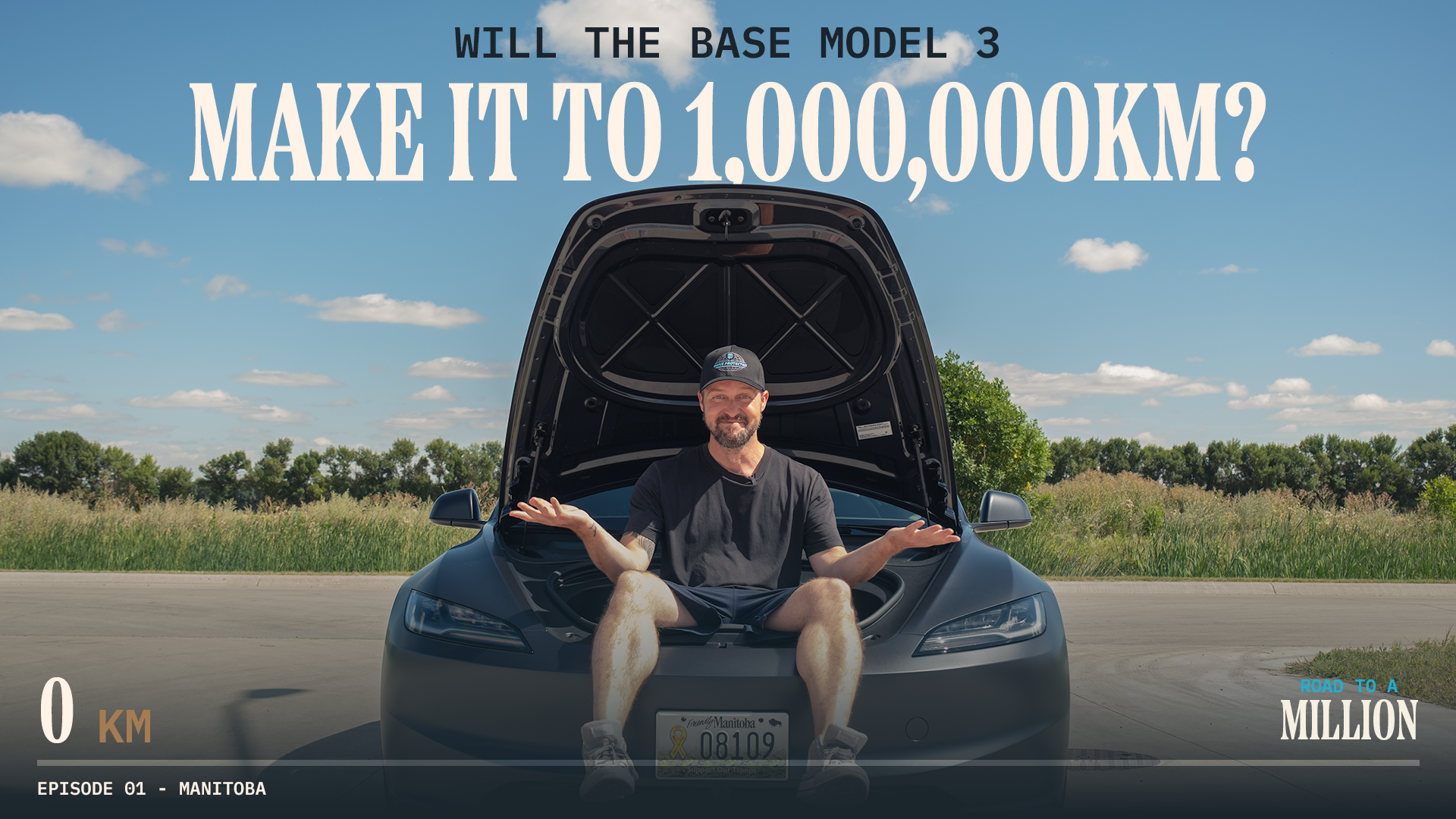
Road to a Million, Episode 1: Buying the Car, Meeting the Driver, and Starting the Craziest Project We've Ever Done
I've been driving EVs, specifically Teslas since 2022, and pretty much from day one I thought: these things are not as bad as people make them sound. They're a ton of fun to drive. But living in Canada, that first winter with my Model Y came with all the usual questions. How will it charge in the cold? Can I even go on road trips? What happens if I get stranded at -30c?
Those are the exact questions I still get asked by anyone skeptical about EVs. It took me a few months of driving through all of it to realize EVs are, in my experience, better to drive than gas vehicles. Bold statement, I know but it's why I haven't bought another gas vehicle since, and I don't plan to until I can afford my dream Porsche.
About three months ago, I was reading an article about CATL, the company that makes the battery in the car we're picking up. The article mentioned their batteries can go a million miles, or a million kilometers, before they're done. That's a wild claim, there's no warranty backing it, and fair enough, because almost nobody in their lifetime will put that kind of mileage on a vehicle anyway.

Then one night at 3 a.m., I woke up with a crazy idea: buy this Model 3 that had just landed in Canada, find someone to drive it, document the whole thing on YouTube, and try to push it to a million kilometers or miles or however far it gets before the battery gives out.
I sat on it for a few hours, went to work the next day, and placed the order. I was careful about who I told not because I doubted it, but because I had this insane amount of confidence that it wasn't just a crazy idea. It felt like the next real step for us as a company. As far as I know, nobody's intentionally bought a vehicle, let alone an EV and tried to drive it to a million kilometers on camera. If that's already been done, I haven't seen it.
Why we're doing this
There's a lot of skepticism around electric vehicles. How far will they really go before the battery dies? Can they handle winter? How long does charging actually take? Everyone asks some version of the same questions, and this series is our attempt to answer them for real, by proving people right or proving them wrong, whichever way it goes.
The whole point is that we're not hiding anything. If the battery dies on the drive home today, we're filming that. Every broken windshield, every tire change, every set of wipers, every charging session, we're tracking it and documenting it. We've got some third party apps that plug straight into Tesla's data, which makes tracking the mileage and costs a lot easier than it would've been otherwise.
We'll show the good, the bad, and the ugly of trying to intentionally run an EV to that kind of mileage in a compressed amount of time. This isn't going to be a small undertaking, and we're not going to pretend it's a Tesla ad, we're not affiliated with Tesla and this project is definitely not sponsored by them. The point is finding out what these cars can actually do.
Why this specific car
This is the cheapest Model 3 you can buy in Canada, and that was deliberate. In Canada, our Model 3s come out of Shanghai and our Model Ys come out of Berlin. We don't get cars from Fremont or Austin, which means most of the American audience has never dealt with a Shanghai-built Model 3 running the CATL battery pack.
That CATL pack is LFP chemistry, which means it can be charged to 100% every single day. The other battery chemistries Tesla uses are typically capped around 80% for daily charging to preserve battery health. The trade off is capacity, this pack is roughly 60–62 kWh, smaller than the alternative but you get to use all of it.

The spec otherwise is about as base as it gets: stealth grey paint (free), black interior (free), 18-inch Photon wheels (free). The only add-on available would've been a tow hitch, and we skipped it since towing isn't part of the plan. It's also rear-wheel drive, which sets up an interesting side experiment: proving you can run a RWD car through a full Canadian winter as long as you've got a proper set of winter tires which we'll be getting separately.
This car is also the realistic entry point for anyone actually considering an EV right now. Tesla currently has it priced at only $39,490 CAD. You get access to the Supercharger network, which keeps expanding into rural Canada plus over-the-air updates and Full Self-Driving, which we'll be running as much as possible for the length of this project.
I talked to the driver ahead of time and told him I was willing to commit two years of full-time wages to this. A million kilometers over two years works out to roughly 1,370 km of driving per day. It's doable, I've personally done 1,500 km in a single day but doing that every day for two years straight is a different kind of challenge entirely. We don't actually expect to hit a million in 2 years but that's the initial time commitment with the driver, it could get extended if the car can keep going.

Picking up the car
Before we signed anything, I asked the sales rep one question: how many kilometers do they think this car can go before the battery no longer works? His answer "research shows the battery will outlast the car itself." When I pushed for a number, he said 600,000–700,000 km. We're about to test that.
Paperwork done, car registered, quick walk-around. Typical Shanghai build quality, which is genuinely impressive. This car will never look as clean as it does right now; it's about to see a lot of miles in a very short amount of time.
Getting in was seamless. I'd already accepted the car in the Tesla app, so the seat and driving position were set before I even sat down, no manual setup needed, since it pulls from your driver profile across vehicles.
Setting everything up
The car walked me through a first time setup flow I hadn't seen before; seating, steering wheel, homepage layout, navigation, charging locations, climate modes (chill, standard, and the FSD-ready settings we're planning to lean on heavily), drive/reverse/park, function keys, hazard lights. Fast, intuitive, nothing surprising for anyone who's owned a Tesla before.
First real task: get the car connected to Tessie, the third-party app we're using to track every drive, every charge, and every cost for the life of this project. That meant enabling telemetry, setting up a phone key, and adding a virtual key, a few extra steps the first time, but smooth once done.
While that synced, I did the one non-negotiable ritual of any new car pickup: peeling off the screen protector. Deeply anticlimactic. Extremely satisfying anyway.
By the time we were back on the road, the odometer had ticked up to about 39 km and one detail worth flagging for anyone doing the same thing: I went into the trip settings and renamed the tracking trip "Road to 1M," and made sure lifetime mileage tracking is set to never reset. Small step, but it matters for a project like this.
Meet the driver
With the idea and the car covered, it's time to introduce the person actually doing this: Ron.
Ron is the driver we've hired specifically for the Road to a Million challenge, and his resume is exactly the kind of unhinged you want for a project like this. His most recent big trip was solo, by motorcycle, from the northern tip of Africa to the southern tip, Morocco down through the west coast to South Africa, all in about six months. Before that, three months and 26 countries across Europe. Before that, nine months and roughly 65,000 km from Alaska to Argentina. All told, he's been to around 90 countries, almost entirely on two wheels.

By his own admission, this project is what he's been training for his whole life even though he's got close to zero experience with EVs. He's not against them, he just doesn't know them yet, which means there's a real learning curve ahead around charging infrastructure that doesn't exist on a motorcycle trip through rural Africa (his words: in the middle of nowhere, you just fill a whiskey bottle with gas, there's no equivalent trick for electricity).
The plan for the next stretch: as many kilometers as possible, nearly every day, for roughly two years, though it could run longer. The clock really stops when the car dies.
For context on what's possible: our giveaway 2019 Model 3 had 610,000 km with the battery still sitting at 70% health, before we swapped the battery. If this car gets taken care of properly, a million kilometers isn't out of the question.
Before Ron heads out, we're kitting the car out to basically double as his home. There will be hotel nights, but there'll also be a lot of nights sleeping in the car, so a mattress is going in. The only modification happening to the car itself is a full wrap in our Defense+ Matte Paint Protection Film (Ron's request) plus window tint, so the car goes into this challenge fully protected from day one.
Where Ron's headed first
Car fully wrapped, Starlink installed, and Ron's first assignment: Dawson City, Yukon. About 4,000 km.
That's episode one and a teaser of what's coming on this wild project. Follow along on YouTube for the full length videos.

Share:
Tesla Model Y vs. Rivian R2
We Lifted a Model Y and Range Tested It. Here's What It Did to the Range