

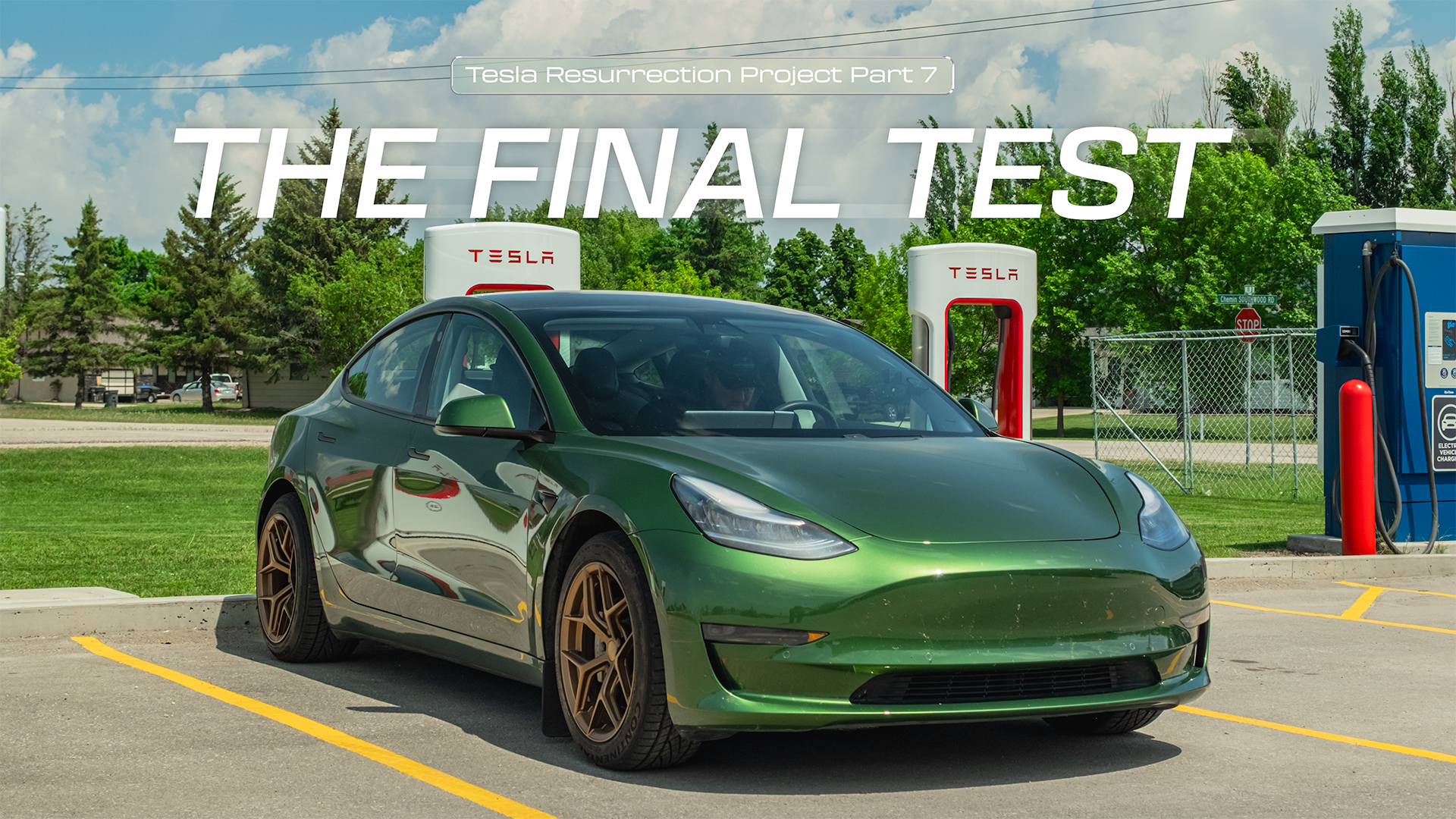
After months of documenting every step of this build, the final episode is the one we've been working toward. New LFP battery. New wrap. A car that started life as a 610,000 km write-off and is now, genuinely, almost new.
We ran two tests in this episode: a full range test from 100% to 0%, and a battery health test to see exactly where the new pack sits. Here's how it went — and what the whole team thinks now that it's done.
The Range Test
We started at 100% state of charge with 386 km showing on the display. Eric called 340 km going in. The plan: hold 110 km/h and check in at every 25% state of charge.
| SOC | Distance | Energy Used | Efficiency |
|---|---|---|---|
| 75% | 71.2 km | 13.6 kWh | 190.2 Wh/km |
| 50% | 140 km | 26.6 kWh | 189.4 Wh/km |
| 25% | 209 km | 39.5 kWh | 189.3 Wh/km |
| 0% | 293.3 km | 53.1 kWh | 181.1 Wh/km |
At the 75% mark, Eric noted a comparison worth calling out: on the original NMC battery, the same checkpoint came at just 55.5 km on 8.1 kWh. The new LFP pack had already covered 71.2 km using 13.6 kWh — more energy drawn, more distance covered. That's the capacity difference between the two packs showing up in real numbers.
Efficiency held consistent through the first three checkpoints on the new pack. By the 50% mark, the pace was projecting around 280 km and confidence in hitting 300 was already sliding. We drove roughly 6 km past 0% on Tesla's buffer to reach the Morris Supercharger. Final result: 293.3 km.
Eric's honest reaction: not impressed. He wanted at least 320 km (200 miles) and anything under 300 was going to sting.
What Held the Range Back
293 km on a brand new LFP pack deserves some context.
Wind. The range test started at 10:15 in the morning. By early afternoon, a major storm system was moving into southern Manitoba. There were tornadoes in the area later that day. Wind built steadily throughout the drive, and it was significant enough that the team was calling it out in real time. Eric's read: if conditions stayed the same as they were at the start, 300 km would have been well within reach.
The tires. This car is running Continental tires on Martian wheels. The rear tires are significantly wider than what the car originally came with, close to the width of two of the stock tires. More contact patch means more rolling resistance, which means more draw on the battery. But man, those wheels look great and the ride is smooth!
The road. Highway 75 on the Canadian side is notoriously rough. For reference: on the drive home from Hamilton after the battery install, the team pulled 260 km despite running 132 km/h against wind over multiple days, a stretch that included I-29 in North Dakota, which is a far smoother road than what this range test was run on.
None of this is making excuses, 293.3 km is the real result on that day in those conditions. But it's not the ceiling, either. This may not be the perfect controlled test but honestly who drives in perfect conditions 100% of the time, this is a more accurate real life situation. You can't always avoid rough roads or winds and it's still good to know what kind of range your EV can get in rougher conditions.
Battery Health Test: 99%
Back at the shop in Winkler, we ran the Tesla battery health test on the new LFP pack.
The process: the car fully discharges the battery through its heating and cooling systems, then charges back to 100%, and measures usable capacity against factory spec. It takes about 16 hours. Tesla limits it to once every six months but since this was a new pack, we got a clean run.
Result: 99% remaining battery capacity.
The battery came out of a 2023 Model 3 Standard Range Plus with around 15,000 km on it. At 17–18,000 km at time of testing, 99% is exactly where it should be.
For perspective: the original NMC pack that came out of this car had 610,000 km on it and was still sitting at 70% health. That says something about how well this car was maintained and what the new owner is inheriting.
What the Team Actually Thinks
We closed the episode with all four of us on camera giving our honest take on the project. The consensus: nobody really wants to give this car away.
Not because it's not ready. It is. Minimal rust work before the wrap, great interior, new suspension, new Martian Wheels with Continental tires and a nearly fresh LFP battery at 99% health. This thing is about as close to a brand new car as a 610,000 km vehicle has any right to be.
The LFP chemistry is worth calling out specifically. Unlike the NMC packs in most Teslas, you can charge an LFP battery to 100% every single day without degradation concern. Faster charge times. Less anxiety around battery management. The winner isn't just getting a restored car, they're getting the better battery chemistry for everyday driving.
One honest note on the RWD setup: if you're in Canada or the northern US, a solid set of winter tires is the move. But given the weight of the car and the right rubber, it's very manageable and sometimes more fun!
The Giveaway
The deadline to enter is July 6. The winner will be announced July 10.
Enter by making any purchase of $25 or more on this site.
Share:
Texas Model 3 - PPF Testimonial
Texas Model S Plaid - DIY PPF Testimonial